
Getting to Know Jeff Puckett: Photographer, Printmaker & Aviator
For the first time, Jeff Puckett shares the stories, inspiration, and experiences that have shaped his life as a photographer, printmaker, and aviator. In this candid conversation, Jeff talks about how he finds inspiration in unexpected places, the moments that become photographs, and the craft behind transforming those photographs into hand-pulled fine art prints.
Go beyond the photographs and get to know the person behind them. Learn about the people, places, and passions that have shaped Jeff’s perspective, inspired his work, and led him down this unique path. Along the way, catch a rare glimpse into the world of Jeff Puckett and the parts of his life that aren’t visible in the final print.
The Call to Create
Was there a particular moment when you realized it would become more than a hobby?
After I sold my business, and slowed down a bit, I had some time on my hands. Although I never stopped taking pictures, I immersed myself in learning about different alternative printing techniques, with a complete emphasis on B&W. I dove off the deep end and purchased a studio/gallery in Denver.
You weren’t always a professional photographer. What did life look like when photography wasn’t your primary focus?
Most of my career has been in the energy sector. For the last 15 years I had a bit of a split career. I partnered in a jet management/charter company, and I helped in the expansion of the business in Colorado. In 2020, I sold my interest to some private equity folks and closed that chapter.
What was the first camera you owned?
A Minolta SRT 101. I purchased it with lawn mowing money when I was 12 years old. I squirreled the money away in a coffee can hidden in my mom’s laundry room - not sure who I thought might steal it.
Do you still have it today?
Unfortunately no. But I’m keeping an eye out on eBay.
Did you have any mentors that helped guide you?
I used to buy a lot of photographer’s books. Ansel Adams of course was a favorite, but my taste varied. Yosuf Karsh, Minor White, André Kertész, Howard Bond, Sebastião Salgado, Imogene Cunningham, and Bernice Abbott to list a few.
Finding Inspiration
How did you discover your artistic voice?
I’m still looking for that sucker!!! All I know is that when I’m discovering things through my camera, and pulling photogravure prints, I’m definitely in my happy place! The stresses of life seem to take the back seat.
Many photographers chase trends. How have you stayed true to your own vision over the years?
That’s difficult to answer. In general, most photographers tend to stick to a certain genre of photography (i.e. street, landscape, portraiture, architecture, etc.). I’ve read often that photographers should stick to one if they want to have any sort of commercial success. I hate to be “should on” - that would bore me. When I see exceptional subjects, that’s when my interest is peaked and I push the shutter release.
Why did you choose to focus on black and white photography?
I shoot black and white only because it forces me, and the viewer, to focus on light, form, and emotion instead of being led around by color. Some subjects only work because of the color. The problem is those aren’t the images that interest me. Stripping the color away forces the viewer to see the bones of the image: light, form, shadow, texture, and tonal contrast. In my opinion, color can be a distraction that competes with what I love in a photograph.
Read more about Jeff’s perspective on black and white photography on the blog: The Art of Seeing Beyond Color
What subjects continue to pull you back, no matter how many times you've photographed them?
I don’t have a particular subject that I return to, but I am drawn to things that the past has left behind. I enjoy making images of buildings, tools, and everyday objects that carry the fingerprints of years gone by. In this vein, I enjoy still lifes in which I can give old, everyday objects a second life. There’s an unexpected beauty that comes out of a well arranged and well photographed selection of old stuff. Maybe not everyone’s cup of tea, but for me, quite fulfilling.
Is there a place you've returned to repeatedly because it continues to reveal something new?
I often return to the Canyonlands in Utah for landscape work. I love the terrain, and it works well with my love for aviation. It’s a fun place to fly to.
The Creative Process
You photograph with both Leica and Phase One cameras. What does each system allow you to create that the other doesn't?
Both cameras can only capture monochromatic files. Their monochrome sensors don’t include a color filter array, so every pixel captures true luminance instead of a single-color channel that gets interpolated. You get roughly double the effective resolution, about a full-stop more sensitivity, and cleaner high-ISO grain. I’m also able to use traditional color filters on my lenses just like we were able to use black and white film back in the day. Many photographers convert their color images to black and white in post, but I guess I’m a bit of a purest.
The Leica M11 Monochrome is a great everyday carry. The variety and quality of their lenses are crazy good. It’s a great camera for those times that don’t demand the use of a tripod, when some stealth is good, and when I don’t need a giant wall sized print.
The Phase One is very much like using an 8x10 view camera. The XT body allows for rise and fall that keeps perspective correct in architectural and landscape photography. The XF body serves more as my studio camera. It’s a wonderful camera for portraiture and still life. The resolution and dynamic range of these cameras are second to none. Both Phase One bodies force the photographer to slow down. When this isn’t a good thing, I grab the Leica.
Check out Jeff’s Phase One camera kit on the Red Dot Forum.
Do you have a favorite time of day to photograph? Favorite season?
I suppose like most photographers, the early morning and late afternoon light is preferred, but I’ve never restricted myself to any particular time of the day. As far as favorite season, I guess winter is my least favorite. Mostly because it’s cold! I have favorite images from every season, however.
What is the most challenging place you’ve ever photographed?
I have a photograph that I took of a rock formation in Moab, Utah that I captured out of my helicopter. The place wasn’t challenging but keeping the helicopter straight and level with my knees was!
What's one photograph you've never taken but still hope to?
Don’t have one. I only know it when I see it.
Do you listen to music when you’re editing or printing?
I do indeed. I like the Van Morrison Mix on Spotify. It tends to play a lot of my favorite bands. Suppose that gives my age away!
How do you know when to stop editing a photograph?
That’s a great question. I must do some and then step away for a while. There is definitely a point where an image can become over edited.
Do you ever go back through a collection of photographs and find one you may have overlooked?
Every day!
What would we find if we walked into your studio?
My home studio is where I do still life type work. It looks like a museum of old and random items. My studio/gallery in lower downtown Denver is where all of my printing takes place. It’s much more organized.
Want to schedule a visit to the Jeff Puckett Images gallery? Contact our team
Of the photographs you take, how many end up as photogravure prints?
My guess is one out of every 100 images I capture ends up as a photogravure. A smaller number seem to demand being big. Those are printed on my 44-inch Epson 9000 using specific Piezography inks formulated for black and white only prints.
What happens if a print doesn’t turn out as you expected?
This can happen for sure. Sometimes my hands can’t produce what my mind pictured. On those, I just have to punt and move to a different favorite image.
The Art of Printmaking
What first fascinated you about the photogravure process?
First and foremost, I love the look of the prints. There is a wonderful mix of modern and late 1800s technology involved. There are numerous stages in the production of one print. Printing then exposing the metal plate. Inking the plate by hand. Hand tearing and soaking the chosen paper. Then the actual pulling of the plate on my press. After the ink has been pressed into the paper, the magic appears as you pull the paper gently off the plate. This part is the reward for all the time and effort. The final print reveal never gets old.
Why is creating a handcrafted print so important to you when digital printing would be much faster?
Most photographers that print their work do so on digital printers. Photogravure prints, in my opinion, are many steps above a typical digital print. Photogravures use oil-based inks that have a richer quality and are archivally superior. There is a unique depth to a photogravure; each print is unique to the one printed prior from the same plate. For collectors this is truly important. I believe that a print created by hand versus one that comes off a digital printer is truly more unique and collectible.
What is the most difficult part of the photogravure process?
Probably obtaining the correct exposure of the plate. This is possibly the most expensive part too. The inking of the plate is also a critical process. It’s much like correct dodging and burning in darkroom days.
And the most rewarding part?
Pulling the paper off the inked plate.
How did you learn the ins and outs of photogravure?
I completed one on one workshops with some of the best in the art of photogravure printing: Don Messec with Making Art Safely in Santa Fe, Jon Cone with Cone Editions in Vermont, and Nathanial Koopercamp and Walker Blackwell at Prints on Paper in Vermont.
What is the longest you’ve ever spent making a single print?
I pulled a photogravure of my image of Saratoga Crosses at 21”x 29” for a collector recently. It’s printed from a large plate. With size comes a bit more complexity.
What do you hope someone notices when they experience one of your photogravure prints for the first time?
First, I hope they like the image itself. Second, I would like them to notice the handmade quality of the print.
The Man Behind the Camera
What hobbies or interests help you recharge when you’re not creating art?
My two grandchildren are first and foremost. They remind me of what is most important in life. Aviation also plays a big role in my life. Just the beauty of flight and focusing on the tasks involved to stay in the air has a way of clearing your mind of outside stresses.
What’s always in your camera bag besides the gear?
Unfortunately, my cell phone.
What books, artists, musicians, or experiences have influenced the way you see the world?
The easy answer is the Bible.
If someone spent a day photographing alongside you, what would probably surprise them about the way you work?
They would probably notice the lack of any real plan. I normally don’t know what I’m going to photograph until it grabs my attention.
What's something people are often surprised to learn about you outside of photography?
I suppose the helicopter thing.
For some cool details on ‘the helicopter thing,’ check out this Airport Journals article about Jeff’s aviation background and how his Prayer One mission started.
Which photograph hanging in your own home means the most to you?
The two portraits I made of my grandkids.
What is the color palette in your house?
A lot of black and white. Big surprise I know.
Do you have a favorite print you’ve produced?
That probably changes weekly. It’s usually the image I pulled last. Currently, I’m very fond of Ucluelet Snails.
Have you ever walked away from a piece of art that you still think about today?
I had a chance to purchase a 20x24 portrait of Ernest Hemingway by Yousuf Karsh many years ago. I shouldn’t have passed on that one.
If you could have dinner with any photographer or artist, living or deceased, who would it be?
It would be a tie for two. André Kertész and Edward Curtis.
Are there photographers you look to for inspiration?
André Kertész, Joel Grimes, and Michael Kenna, amongst many others. Who are the top three you follow on IG? I enjoy the work of Alan Schaller, Alan Bouti, and Jeff Puckett (ha).
How has photography changed the way you see the world?
It continues to open my eyes that there is beauty in the mundane that is easily overlooked.
Has your definition of a great photograph changed over the years?
My interests in different genres of photography have increased. I’m not nearly as focused on landscape as I was long ago, although I do still love it.
Quick Fire
Coffee or tea? Coffee
Mountains or coast? Coast
Sunrise or sunset? Sunrise
Leica or Phase One? Don’t make me! Different tools for different times.
Favorite museum? The Getty Museum
Favorite city? Today’s favorite is San Miguel de Allende
Favorite place to unwind? Mexico
Minimalist or maximalist? Minimalist
Looking Ahead
What are you still hoping to photograph that you haven't yet?
In general, I’m hoping to spend more time in portraiture.
Are there any bucket list places you have yet to visit that you want to photograph?
Africa.
What is the next camera or lens you plan to purchase?
None currently. I’d like to stay married.
Technology is evolving fast. Any thoughts on the future of fine art photography and hand-crafted prints?
Now that almost everyone in the world is carrying a camera (cell phone), and their photographs live digitally, I think hand-crafted prints will only become more special and more collectible.
If collectors walk away with one thought after they've spent time with your work, what would you hope it is?
That this photographer found something very interesting in the unexpected and has presented it in a unique medium.
What’s next for your gallery? For your art?
I’m hoping to have a show of new work at the Jeff Puckett Images gallery in 2027. I’m going to focus on printing 8”x10” plates for the show. I usually print larger.
What has photography given you that you never expected?
After enough years, I notice light on a wall, the geometry of our world, a stranger’s hands. The camera has rewired my eyes permanently, whether I’m carrying one or not.
What do you hope your art gives to someone else?
I guess in the world of scrolling, I hope that my prints on a wall would actually stop a person long enough to take a breath, leave their phone in their pocket, and come to the realization that there truly is beauty in the unexpected…..and realize this guy must have put a lot of love and effort into this sucker!
Featured Photogravure Print
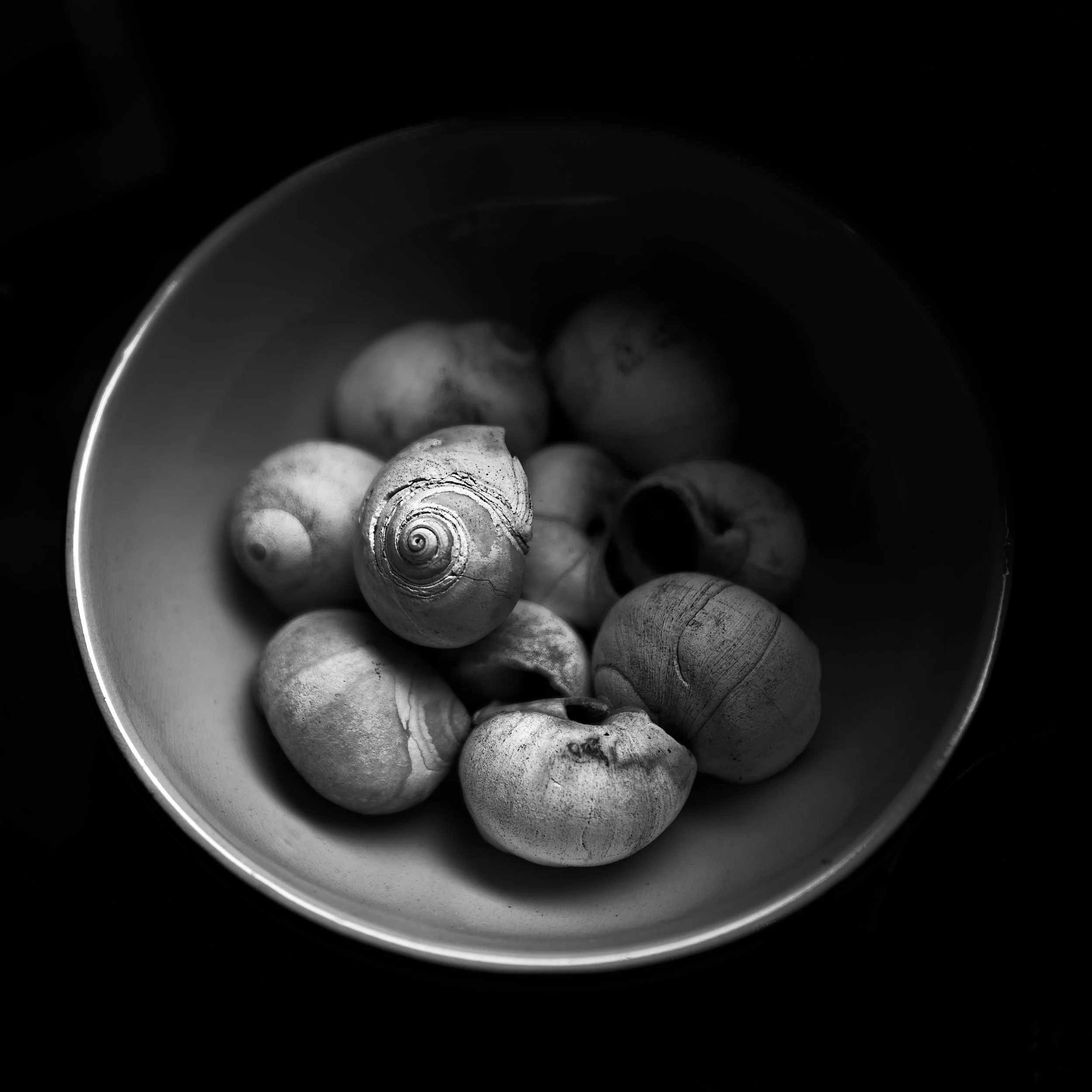
Photogravure. 15”x15” Framed
from $1000
Limited Edition Hand printed Photogravure